Wired for More: A Student’s Journey from Warehouse Floor to Power Grid
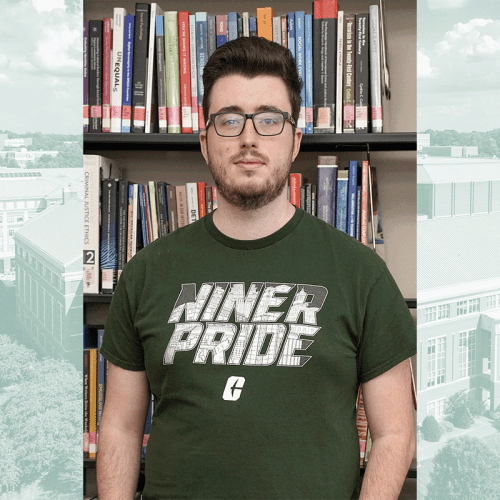
At 3 a.m., when most of Charlotte is asleep, Nikita Conner is already moving. Steel-toed boots on. Hands working by muscle memory. Packages sliding down conveyor belts, destined for homes across the country. It’s demanding work, but for Conner, it’s also temporary.
Every box he lifts brings him closer to a future built not in a warehouse, but in control rooms, power grids, and engineering offices.
Conner is an electrical engineering student at UNC Charlotte, pursuing both his bachelor’s and master’s degrees through the University’s Early Entry program. At the same time, he’s a Tier One employee at Amazon, where he’s worked for nearly five years. The connection between those two worlds is Amazon Career Choice, a program that provides him with up to $5,250 per year in tuition assistance.
Amazon’s agreement with UNC Charlotte is just one of many tuition benefit partnerships the University has with other businesses that provide employees opportunities to further their education. They’re opportunities that, for Conner, have been life-changing.
“It means a lot just knowing that at the end of the day, I don’t have to worry about being buried in student loans,” he says. “That peace of mind is a blessing. It lets me focus on my classes.”
Engineering was always in the background. Math and science came naturally. But electrical engineering didn’t fully click until he started exploring UNC Charlotte’s program.
“Electrical didn’t really come until I was applying to UNC Charlotte and seeing what the applications were,” Conner says. “Electrical engineering is everywhere. I thought it would be a good way to start, and if I had issues, I could always pivot. But once I started taking classes and really learning what it was, I realized it was right up my alley.”
Now deep into the curriculum, Conner is especially drawn to power systems: work that underpins companies like Duke Energy and supports entire communities.
“With the emergence of AI, there are a lot of exciting opportunities in monitoring and metering,” he says. “Those tools are way more accessible now. We can actually see what’s happening in real time, and that’s what I’m focusing my classes on.”
His favorite course so far is Power Systems Analysis, taught by Dr. Chowdhury. He’s currently in the second course in the sequence, building on concepts that feel increasingly real.
“It’s exciting because you’re not just learning theory,” he says. “You’re learning how this actually applies in the real world.”
That real-world connection shows up in his senior design project, which focuses on protection schemes for electrical distribution and transmission systems.
“If there’s a lightning strike or a tree falls on a power line, that’s bad,” Conner explains. “It can cause fires or damage multimillion-dollar equipment. What we’re learning is how to detect those faults, calculate what’s happening, and prevent bigger problems. That’s been really exciting for me.”
Balancing school with work hasn’t been easy. This semester, Conner is taking 17 credit hours. Amazon’s educational work break allows him to step away from work during the semester while remaining an employee, making the load manageable.
Looking ahead five or ten years, Conner sees two possible paths.
“The ambitious answer is I’d like to start my own company,” he says. “Consulting for electrical companies, hopefully something long-term. If not, I’d love to work for a company like Duke or ePriv, get hands-on experience, and grow in the industry.”
Through it all, his family has been his foundation. And when asked what he’s most proud of, his answer is immediate.
“I never gave up,” Conner says. “I knew I wasn’t going to stop until I got my degree. Just keeping up, pushing through, and knowing I belong here. That’s a real source of pride.”
UNC Charlotte itself has been a surprise in the best way.
“I’ve really enjoyed the campus,” he says. “The Student Union, the food, U-REC. I play pickleball there every week. The buses make it easy to get around. It just works.”
For anyone nervous about returning to school after time away, Conner doesn’t sugarcoat it.
“There’s never a perfect time,” he says. “It doesn’t get easier the longer you wait. You decide how you want to live your life. Taking that first step now makes everything later a lot easier.”
By December, Conner will complete his master’s degree. The warehouse lights will fade into memory. What remains is something stronger: unwavering determination, hard-earned opportunity, and a future he built, one decision at a time.