Innovative partnership uses credit for prior learning to expand access for teachers
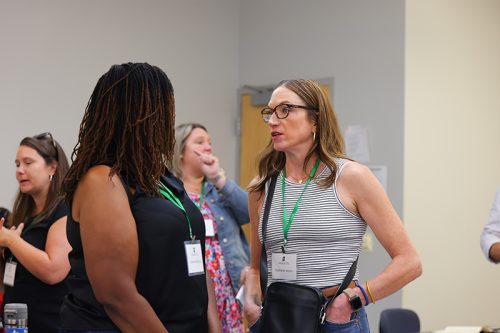
UNC Charlotte’s Cato College of Education is demonstrating how credit for prior learning can transform graduate education through an innovative partnership with Cabarrus County Schools.
This summer, 25 teachers from Cabarrus County Public Schools began UNC Charlotte’s Graduate Certificate in Instructional Coaching through a model that reduces both the cost and time required to complete the credential. Instead of taking the program’s first 8-week course online, participants attended an intensive summer institute led by Cato College of Education faculty. Because the workshop’s learning outcomes aligned with the first course in the certificate, participants earned academic credit through UNC Charlotte’s credit for prior learning policy.
The result: teachers complete the four-course graduate certificate by taking just three additional courses, reducing both tuition costs and time to completion while still earning the same credential.
“This is a model that I think we could replicate in other areas,” said Sejal Foxx, professor and interim associate dean of research and graduate education in the Cato College of Education. “We are able to build on Dr. Scott Kissau’s early work, recognizing the skills professionals have already developed before they enter our graduate programs.”
The partnership also addresses a growing need within K-12 education. As school districts increasingly adopt instructional coaching models, experienced classroom teachers are taking on leadership roles mentoring and coaching fellow educators. While these teachers excel in the classroom, many have never received formal training in coaching strategies.
“Our certificate prepares effective teachers to become effective instructional coaches,” said certificate director, Luke Reinke, associate professor of mathematics education. “Cabarrus County recognized the need, and together we developed a solution that benefits both the district and its teachers.” Cabarrus County Public Schools is also covering tuition and fees for participants, making the Tuition Benefit Partnership and credit for prior learning combination a win-win for the students.
Dean Malcolm Butler emphasized the immediate impact on the district and its students. “This synergistic partnership with Cabarrus County Schools means more teacher leaders are trained and prepared to support their fellow teachers in improving their instructional skills, which then in turn improves student learning and achievement.”
This speaks directly to the broader potential of credit for prior learning across the University. Updated at UNC Charlotte in December, the policy allows eligible students to receive academic credit for prior professional learning when it demonstrates the same learning outcomes as University coursework.
“Faculty have an opportunity to look at their programs differently,” Foxx said. “Many professionals come to us with valuable experience, continuing education credits or industry training. If that learning aligns with program quality and course outcomes, credit for prior learning can help students move more efficiently toward completing their degrees.”
As UNC Charlotte expands Credit for Prior Learning, partnerships similar to Cabarrus County Schools show how academic innovation reduces barriers, boosts workforce ties and opens new graduate pathways. To learn more about Credit for Prior Learning at UNC Charlotte, contact Matthieu Castillo at cplsupport@charlotte.edu.